
 0
0



- Home
- Blog
- Standards and Certification
- Application of color difference ΔE (Delta E)
Application of color difference ΔE (Delta E)
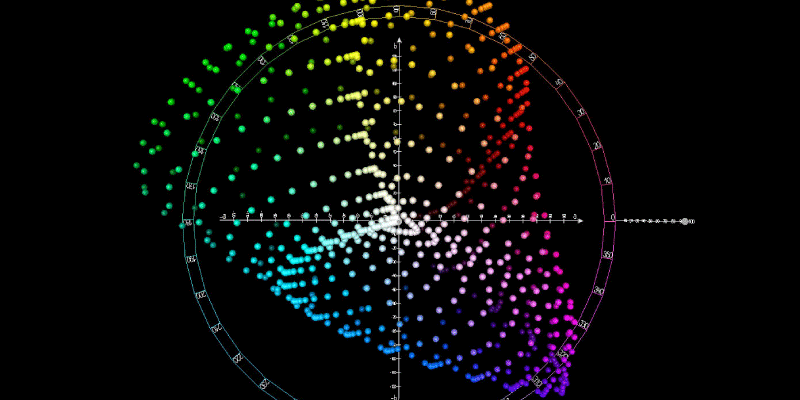
Lab mode is a theoretical mode for recording the color of light.
CIE (Commission Internationale de l'Eclairage) is the international standard for measuring color and determining color values.
CIE has established L*, a*, and b* values to measure color values; this measurement method is called CIELAB.
L* represents lightness, ranging from bright (L*=100) to dark (L*=0).
a* value represents the color variation from green (-a*) to red (+a*).
b* value represents the color variation from yellow (+b*) to blue (-b*).
What is ΔE (Delta E)?
ΔE is a metric established by the International Commission on Illumination (ICI) to quantify the difference between two colors displayed on a screen. When purchasing a projector or digital monitor, you'll want to find a device with a ΔE value as close to zero as possible.
The ΔE value represents the difference between the "displayed color" and the "original color standard of the input content." A lower ΔE value indicates higher accuracy, while a higher ΔE value indicates a more pronounced color difference.
The "E" in ΔE stands for "Empfindung," the German word for "sensation." Δ (Delta) is Greek, representing a progressive change in a variable. Overall, the term ΔE means a difference in perception.
ΔE is measured between 0 and 100; the closer to 0, the smaller the color difference, while 100 indicates complete distortion.
Color Difference Calculation: Input the CIE Lab values of the standard and sample colors to obtain the color difference value between the two colors.
ΔE (Total Color Difference) is a complete numerical descriptor derived from the three color values (delta L*, delta a*, and delta b*) in a rectangular coordinate system. Its meanings are as follows:
dL* represents the brightness difference between the sample and standard colors.
da* represents the redness or grayness difference between the sample and standard colors.
db* represents the blue-yellowness difference between the sample and standard colors.
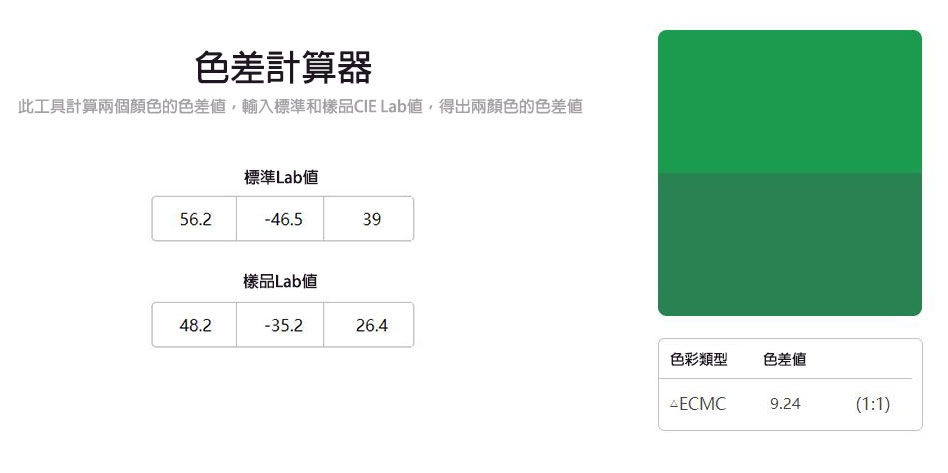
Color Difference Value Range Judgment
【ΔE value between 1.6 and 3.2】
The human eye can barely distinguish the color difference; they are usually considered the same color.
【ΔE value between 3.2 and 6.5】
Trained professionals can distinguish the difference, but ordinary people cannot observe the difference; they give the impression of being basically the same.
【ΔE value between 6.5 and 13】
The color difference is visible, but it can be considered the same hue.
【ΔE value between 13 and 25】
Considered different hues; values exceeding this range are considered different colors.
Delta-E (ΔE) Applications
CIELab (1976) is widely used in offset printing.
CIE2000, the optimal color difference formula, is an improved version based on CIELab (1976) and has been defined as the new standard by ISO.
CMC is widely used in the printing and dyeing industry.
CIE94 is applied in the textile field.
Source of relevant information:
CMYK Image Color Difference: Buyer Expectations vs. Printer Capabilities
Color management and color difference control in printing
Related Links:
Taoyuan Printing , Taoyuan Sticker Printing ,

Web Aggregate Resources
Articles collected, integrated, and revised by Santa's editorial team from publicly available online resources.


Article Classification
Recent Articles
- Labeling standards include: North American UL, Canadian CSA safety certification labels and stickers
- Introduction to the International Maritime Dangerous Goods Code (IMDG Code)
- Distinguishing between UL Label Safety Certification Categories (US Standard)
- Labels are more than just printing: A complete guide to high-performance labels and compliance marking.
- ISO